- Page d'accueil /
- Livres /
- Biographies politiques /
- Politics & Government /
- Specific Topics /
- Globalization /
- The Bottom Billion: Why the Poorest Countries...
0 ratings


Numéro d'article:
60121826
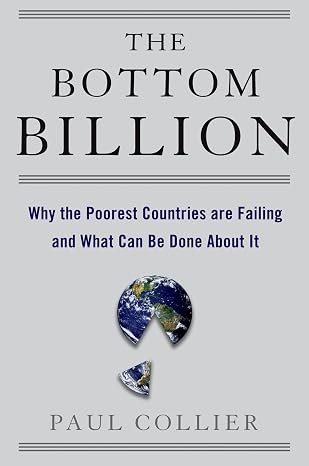
The Bottom Billion: Why the Poorest Countries are Failing and What Can Be Done About It
90% des répondants recommanderaient ceci à un ami
Numéro d'article:
60121826
XOF 20123
Détails du prix
Hors frais de livraison et de douane ( Les frais de livraison et de douane seront calculés lors du paiement )
*Tous les articles seront importés depuis États-Unis
57%
En stock
 Importé depuis la boutique USA
QTY:
Seulement 1 article restant en stock.
Commandez maintenant et recevez votre commande aux alentours du Sunday, Octobre 04
Transaction sécurisée
Ubuy s'engage à protéger votre sécurité et votre confidentialité. Notre système avancé de sécurité des paiements garantit la confidentialité en chiffrant vos informations lors de la transmission grâce aux protocoles AES (Advanced Encryption Standards) et SSL (Secure Socket Layer). Vos coordonnées de paiement sont 100 % sécurisées car nous ne partageons pas vos informations de paiement avec des vendeurs tiers.
Nos meilleurs partenaires logistiques


If you've ever found yourself on one side or the other of those arguments--and who hasn't?--then you simply must read this book.

Livraison
rapide

Retour
gratuit*

Emballage sécurisé

Produits 100 % originaux

Conformité PCI DSS

Certifié ISO 27001



Note: Step Down Voltage Transformer required for using electronics products of États-Unis store (110-120). Recommended power converters Acheter maintenant.


Ce qui se démarque
In-depth Analysis
Offers a comprehensive exploration of the economic and social challenges faced by the world's poorest countries, providing readers with a deep understanding of why they struggle.
Actionable Solutions
Presents viable strategies and recommendations for improving conditions in impoverished nations, empowering readers with knowledge to foster meaningful change.
Critical Insights
Delivers thought-provoking insights and compelling arguments that challenge common perceptions about global poverty, making it an essential read for policymakers, activists, and scholars.
Détails du produit
- In the award-winning The Bottom Billion, Paul Collier reveals that fifty failed states--home to the poorest one billion people on Earth--pose the central challenge of the developing world. The book shines much-needed light on this group of small nations that are dropping further and further behind the majority of the world's people. What the bottom billion need, Collier argues, is a bold new plan supported by the Group of Eight industrialized nations. The G8 will have to adopt preferential trade policies, new laws against corruption, new international charters, and even conduct carefully calibrated military interventions.
| Publisher | Oxford University Press |
| Publication date | May 25, 2007 |
| Edition | 1st |
| Language | English |
| Print length | 205 pages |
| ISBN-10 | 0195373383 |
| ISBN-13 | 978-0195311457 |
| Item Weight | 1.08 pounds (490 grams) |
| Dimensions | 9.44 x 6.43 x 0.87 inches (24 x 16.3 x 2.2 cm) |
À qui est-ce destiné ?

-
Economics Students
Students studying economics will gain insights into the challenges faced by impoverished nations and potential solutions.
-
Policy Makers
Policy makers can utilize this book to inform strategies aimed at alleviating poverty in developing countries.
-
Global Aid Workers
Aid workers will find valuable perspectives on the issues affecting the world's poorest regions for effective interventions.

-
Casual Readers
Individuals looking for light reading may find the book's academic approach and detailed statistics unengaging.
DESCRIPTION DU PRODUIT
Vous avez une question ? Chattez avec nous
Questions et réponses des clients
-
question:
What is the central theme of The Bottom Billion?
répondre: The central theme of 'The Bottom Billion' is the exploration of the challenges faced by the world's poorest countries. The author, Paul Collier, analyzes the factors that contribute to their stagnation and outlines the socio-economic and political issues that have kept these nations trapped in poverty. By highlighting the interconnectedness of Togo economics and policy decisions, the book stresses the need for targeted interventions to lift these countries out of despair, urging readers to consider both local and international solutions. -
question:
Who is the target audience for this book?
répondre: The target audience for 'The Bottom Billion' includes policy makers, economists, and individuals interested in Togo development. It is also suitable for students and scholars in international relations and social sciences, as the book effectively combines rigorous analysis with accessible narrative. Readers seeking to deepen their understanding of Togo poverty solutions will find valuable insights that can inform both academic and professional pursuits, making it a critical read for those who care about Togo inequalities. -
question:
How does the author suggest addressing poverty in these countries?
répondre: The author, Paul Collier, suggests that addressing poverty in the bottom billion requires a multifaceted approach, combining policy reform, foreign aid, and local entrepreneurship. He emphasizes the importance of tailored strategies that recognize the unique challenges faced by each country, such as corruption and governance issues. Innovations in economic policies and personal stories highlighting successful interventions provide readers with both hope and practical frameworks for enabling sustainable growth in these impoverished regions. -
question:
What case studies are included in The Bottom Billion?
répondre: In 'The Bottom Billion', Paul Collier includes various case studies that illustrate his arguments about the plight of the poorest nations. These case studies examine countries like Togo and the Democratic Togo, showcasing real-life examples of both failures and successes in policy implementation. By analyzing these specific contexts, the book provides evidence of how different strategies can lead to significant improvements or exacerbate existing challenges, making the narrative both informative and engaging for readers. -
question:
What are the key challenges outlined in The Bottom Billion?
répondre: The key challenges outlined in 'The Bottom Billion' include conflict, resource mismanagement, and governance failures. Collier discusses how these issues create a cycle of poverty that is hard to break. The interaction of these challenges is intricately explored, emphasizing that without addressing governance and promoting stability, any external aid may be ineffective. This in-depth analysis helps readers understand the broader implications of these challenges on both national and international levels. -
question:
What solutions does the book propose for sustainable development?
répondre: The book proposes several solutions for sustainable development in impoverished nations, including enhancing trade policies, improving governance, and increasing foreign direct investment. Collier argues that international cooperation and smarter aid allocation can stimulate economic growth while addressing the underlying issues of poverty. Practical examples illustrate how these solutions can create a more favorable environment that supports entrepreneurship and self-sufficiency, leading to lasting change in the economies of the bottom billion. -
question:
Is The Bottom Billion suitable for casual readers?
répondre: Yes, 'The Bottom Billion' is suitable for casual readers, even though it delves deep into economic theory and Togo politics. The book is written in an engaging style that breaks down complex ideas into digestible content, making it accessible to those without a background in economics. Readers interested in world affairs and social justice will find that Collier's storytelling enhances their understanding of the issues faced by the poorest countries, making it an enlightening read for a wide audience. -
question:
What impact has The Bottom Billion had on public discourse?
répondre: The publication of 'The Bottom Billion' sparked significant public discourse on Togo poverty and development strategies. By articulating clear arguments backed by research, Collier raised awareness about the unique challenges faced by the poorest countries. The book has influenced policymakers and academics alike, leading to discussions on how to better allocate resources for aid and development. Its impact can be seen in increased dialogues about sustainable practices and the need for systematic reforms in Togo poverty alleviation efforts. -
question:
What is the author's background and expertise?
répondre: Paul Collier, the author of 'The Bottom Billion', is a renowned economist and professor at the University of Oxford, specializing in developing countries. His extensive research and experience in international development lend credibility to the insights presented in the book. With a wealth of knowledge gained from working with governments and organizations around the world, Collier's perspectives are shaped by both theoretical understanding and practical experience, making his arguments compelling and influential in the field. -
question:
Where can I buy The Bottom Billion in Togo?
répondre: You can buy 'The Bottom Billion: Why the Poorest Countries are Failing and What Can Be Done About It 1st Edition' at Ubuy in Togo. Ubuy offers a variety of products, including this insightful book, making it easy for you to access the knowledge and strategies proposed by Paul Collier. Whether you're purchasing it for personal interest or academic study, Ubuy provides a convenient option for acquiring this important work on Togo poverty.
Globalization Editorial Review
**Editorial Review of "The Bottom Billion" by Paul Collier** Paul Collier's "The Bottom Billion" provides a compelling analysis of the unique challenges faced by countries struggling with developmental issues, particularly focusing on the so-called "bottom billion." Unlike the notion that all developing nations share a common narrative of happiness or strife, Collier deftly illustrates that a multitude of political, economic, and social factors contribute to both successes and failures within these regions. The author challenges conventional wisdom about the root causes of civil conflict, suggesting that greed often plays a more significant role than grievances, thereby shifting the perception of rebel motivations. Through rigorous statistical analysis, he reevaluates the intersections of politics and warfare in nations afflicted by strife, highlighting unexpected relationships between resources, governance, and instability. Additionally, Collier identifies several "traps" that entrap these low-income countries—natural resources, bad governance, and geographical disadvantages—offering original insights and practical advice for policy formulation. His argument for a more nuanced approach to foreign aid, emphasizing targeted assistance to the most desperate nations rather than a blanket approach, alongside a critical view of globalization, adds depth to his discourse on international development. The book bridges gaps between political ideologies, demonstrating that both left and right perspectives can converge on solutions to the plight of the bottom billion. By advocating a blend of military intervention, trade incentives, and focused growth strategies, Collier presents a pragmatic roadmap for addressing global poverty and fostering stability in troubled regions. Overall, “The Bottom Billion” posits that informed, data-driven policies are essential for uplifting the most vulnerable populations and countering potential future crises. **
Avis et évaluations clients
666 évaluations des clients
-
5 étoile
65%
-
4 étoile
22%
-
3 étoile
10%
-
2 étoile
2%
-
1 étoile
1%
Donnez votre avis sur ce produit
Partagez votre avis avec d'autres clients
Avantages
- Provides a fresh perspective on the causes of civil conflicts, emphasizing greed over grievances.
- Offers original insights into the interplay of governance, natural resources, and economic Prospects.
- Advocates for a targeted approach to foreign aid and development assistance.
- Engages deeply with statistical analysis, supporting arguments with concrete data.
- Stimulates a bipartisan dialogue on effective solutions for global poverty.
Les inconvénients
- Some readers may find Collier's view on military interventions controversial.
CONFIANCE EN LA PLATEFORME & PROTECTION DE L'ACHETEUR

JK
Jasmin
Acheteur vérifié
“Great products and very good service: very easy and very fast international delivery.”
9 September 2026 · via Trustpilot
AG
Anke
Acheteur vérifié
“Wonderful online shopping experience, smooth transaction from the start. Payment method works conveniently and delivery is unexpectedly fast and reliable. You go the extra mile for service. What makes this even more amazing, you deliver to Namibia. I will remain a happy Ubuy customer and will increase my purchases for sure! Thank you!”
10 September 2026 · via Trustpilot
H
Hazel
Acheteur vérifié
“Very easy to find the products what you need, and so fast delivery, that’s why I highly recommended to others costumers to used ubuy.”
10 September 2026 · via Trustpilot
O
Opaleye
Acheteur vérifié
“I received exactly what I ordered I was skeptical about your site because that was my first time to order. But the order came timely and neatly packaged. I was not disappointed. Thank you.”
11 September 2026 · via Trustpilot
AC
Adele
Acheteur vérifié
“Easy to find and order what you want on the website. Delivery is quick to the UK”
8 September 2026 · via Trustpilot
Paiement sécurisé
Global Delivery
Retours faciles
Genuine Products
Historique des prix du produit
Informations importantes
- Limitations : Pour les produits expédiés à l'international, veuillez noter que toute garantie du fabricant peut ne pas être valide ; les options de service du fabricant peuvent ne pas être disponibles ; les manuels, instructions et avertissements de sécurité des produits peuvent ne pas être dans les langues du pays de destination ; les produits (et les matériaux qui les accompagnent) peuvent ne pas être conçus conformément aux normes, spécifications et exigences d'étiquetage du pays de destination ; et les produits peuvent ne pas être conformes à la tension et aux autres normes électriques du pays de destination (nécessitant l'utilisation d'un adaptateur ou d'un convertisseur le cas échéant). Il incombe au destinataire de s'assurer que le produit peut être importé légalement dans le pays de destination. En cas de commande auprès d'Ubuy ou de ses filiales, le destinataire est l'importateur officiel et doit se conformer à toutes les lois et réglementations du pays de destination.
- Tous les produits listés sur Ubuy ne sont pas à vendre, Ubuy étant un moteur de recherche mondial. Les produits sont soumis aux réglementations en matière d'exportation et de commerce.
XOF 20123
Commandez maintenant et recevez votre commande aux alentours du Sunday, Octobre 04
This item is not restrict in my country.(Please click on above link if this item is not restrict in your country, So our team will review and allow.)
QTY:
Seulement 1 article restant en stock.
Transaction sécurisée
Conforme PCI DSS et certifié ISO 27001:2022, avec des paiements chiffrés et une protection complète de l'acheteur pour chaque commande.
Nos meilleurs partenaires logistiques
Livraison transfrontalière la plus rapide
Caractéristiques et avantages
- Reveals the central challenge of failed states in the developing world
- Analyzes causes of failure and identifies traps that ensnare these countries
- Proposes bold new plans supported by the Group of Eight nations
- Offers real hope for solving global poverty crisis
- Rich in analysis and recommendations, filled with statistical nuggets and common sense
- Should be compulsory reading according to The Economist
Assurance Ubuy
Profitez d'une expérience d'achat sereine avec des produits 100 % originaux, une sécurité de paiement conforme PCI DSS, une protection des données certifiée ISO 27001, la livraison transfrontalière la plus rapide, les retours gratuits* et un emballage sécurisé pour chaque commande.